Planetary Geologist and Communications Specialist
Yesenia Arroyo
(They/them/theirs)
Exoplanets and Stellar Astrophysics Laboratory (667)
Did you always know that you wanted to study planetary geology?
I don’t remember talking about it much as a kid. But I recently reconnected with an elementary school classmate, and he expressed how happy he was that I worked at Goddard since I “have always been passionate about space.” So, I may not have always known the job title, but I think I always knew it had to be space.
I was raised by my grandparents. My grandma, imagine a drill sergeant, then imagine the drill sergeant for that drill sergeant, kept me within arm’s reach. Even local field trips to the Miami Seaquarium or county fair were off-limits. So, when I asked about a school trip 250 miles away to Kennedy Space Center, I didn’t think she’d say yes. But she must have sensed how much it meant, because for the first time she allowed it—on the condition that I ‘figure out how to pay for it.’ Our school gave us the option to fundraise the money to attend and, well, I wasn’t going to let a little thing like money stop me from going! I sold so much chocolate for this trip that my teacher let me bring a friend along. The first time I saw the Saturn V in person, I was awestruck. That feeling has been my north star ever since.
Funny enough, that north star didn’t point me out to space but to geology, a discipline that I thought only really applied to Earth. But it turns out that rocks are some of the best storytellers in the solar system. They speak a beautiful language; one that can tell the history of an entire planet! Don’t underestimate how much a rock has to say.

(Bottom) In front of STS-134, 9 years later.
Tell us about the research projects you are currently working on.
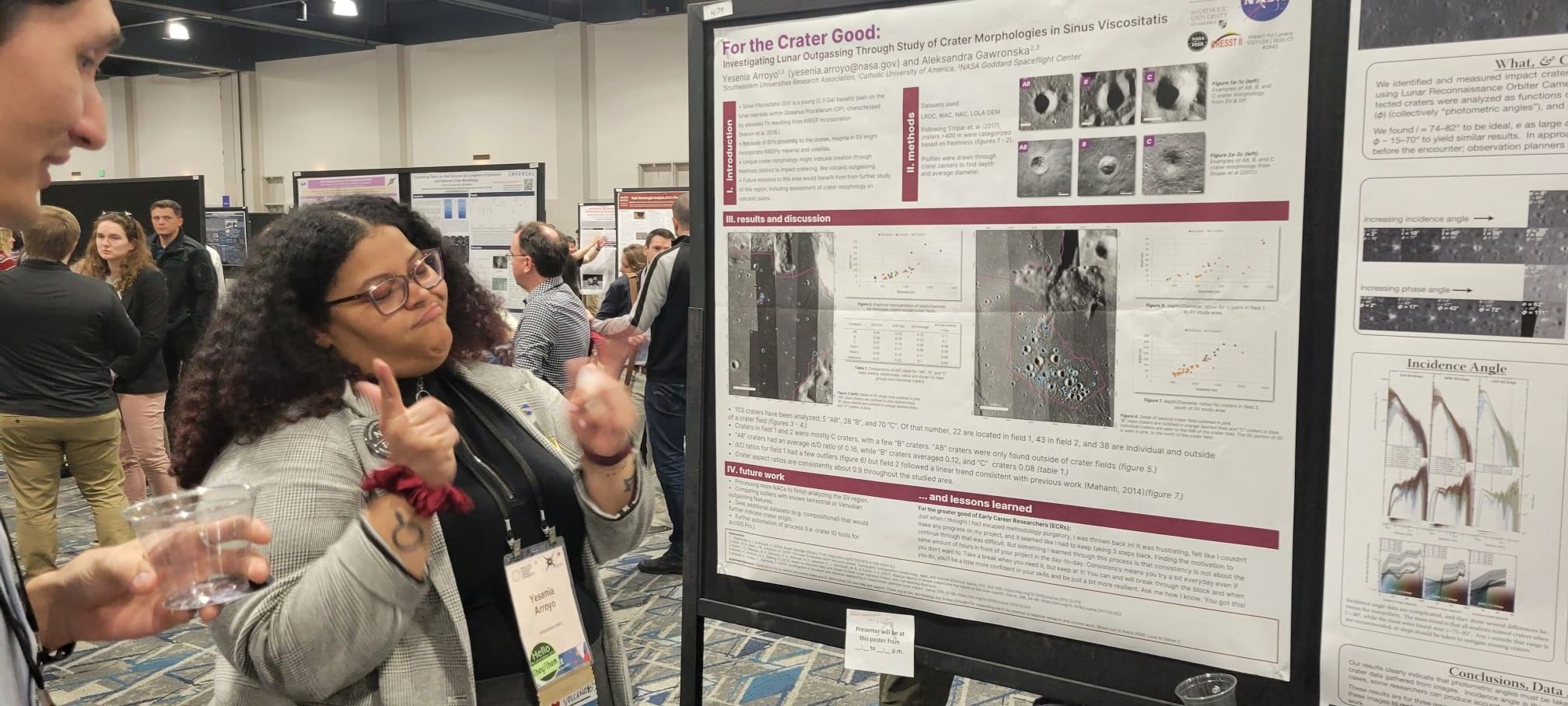
When I came to Goddard, I had a stretch goal of trying out a research project, figuring out some interests, and seeing where they led. Thanks to Drs. Barb Cohen and Aleks Gawronska, I found my footing in an award-winning project (shoutout Code 600 poster party!) .I’ve been calling For the Crater Good.
The project looks at craters in Sinus Viscositatis, a basalt patch near the Gruithuisen Domes. The Domes are an unusual set of volcanic structures on the Moon, that share many characteristics with terrestrial silicic domes. However, the Moon lacks the mechanisms typically required to form silicic domes (i.e. plate tectonics or an abundance of volatiles like water). This suggests that there could have been, or still might be, that hidden volatiles in the region. My role was to study crater shapes, depths, and diameters to see if there were any that didn’t match expected impact data. The idea is that if I were to find any craters with weird numbers, they could point to being formed through non-impact formation processes, like volcanic outgassing of volatiles. After all, when is an impact crater not an impact crater? When it’s an outgassing pit! You can read more about this project on my website.
What’s been most meaningful, though, is what I’ve learned about myself. I graduated during the pandemic, which shook my confidence and made me hesitant to even call myself a scientist. But through this project, I’ve learned that research isn’t about having all the answers; it’s about being determined and resourceful. So, I’m trying to learn to trust in my abilities and appreciate how much I’ve accomplished. I’ve come a long way!
What is one of your favorite moments in your career so far?
I can’t do just one! Each milestone has shaped a different part of me.
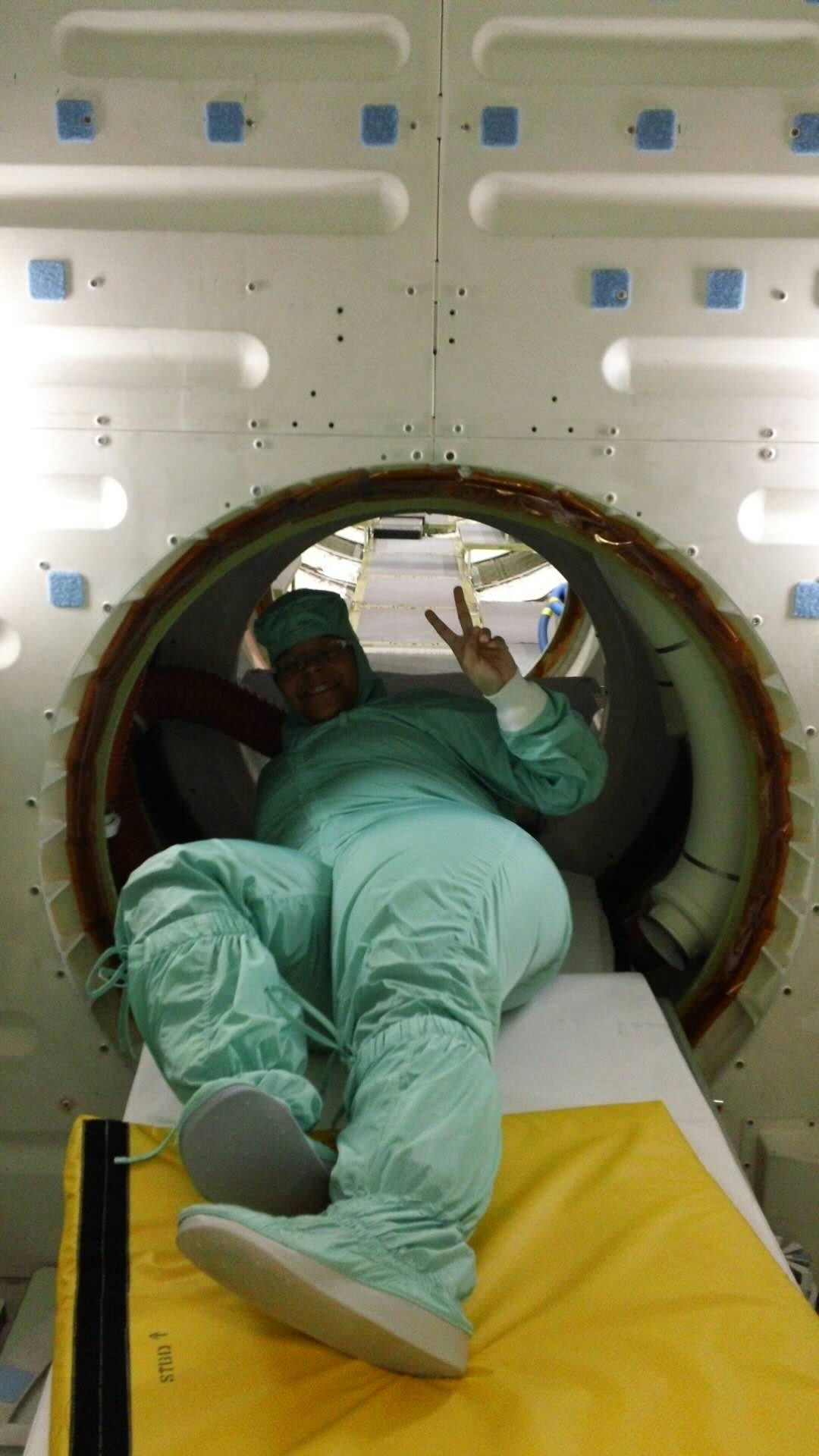
At the end of my first year of undergrad, I applied to a KSC internship on a whim, and I got it because of my aircraft maintenance experience! Supporting STS-133, 134, and 135 is a privilege I will forever be grateful for and helped me identify that the thrilling feeling I got from supporting mission science is what I wanted to chase in my career.
As an educator with the Orlando Science Center, I ran science demos in some odd locations and ended up on-stage at a Radio Disney concert and at Epic McD, the world’s largest McDonald’s. This really helped me embrace how fun and surprising sci-comm can be. Both audiences were confused about why I was there, but they were into it by the time I was done. This style of sci-comm still informs how I engage and talk with people today.
I failed out of my first undergrad program in 2015 when extenuating financial and personal circumstances became too much to handle. I blamed myself for this for a long time. But looking back, these circumstances were nearly impossible to navigate without a community to ask for help. It took a lot of effort to get back into academia. So, graduating cum laude from UF in 2021 was a hugely affirming. It was proof that I could persevere, and I could achieve things I set my mind to and that sometimes it really does take a village!

(Right) Walking across the stage at graduation. Yesenia is holding up a stole with the flag of the Dominican Republic.
What excites me most, other than the fact that it will search for life on other planets, is that we’re doing comms earlier than usual.
Are you involved in any upcoming space missions?
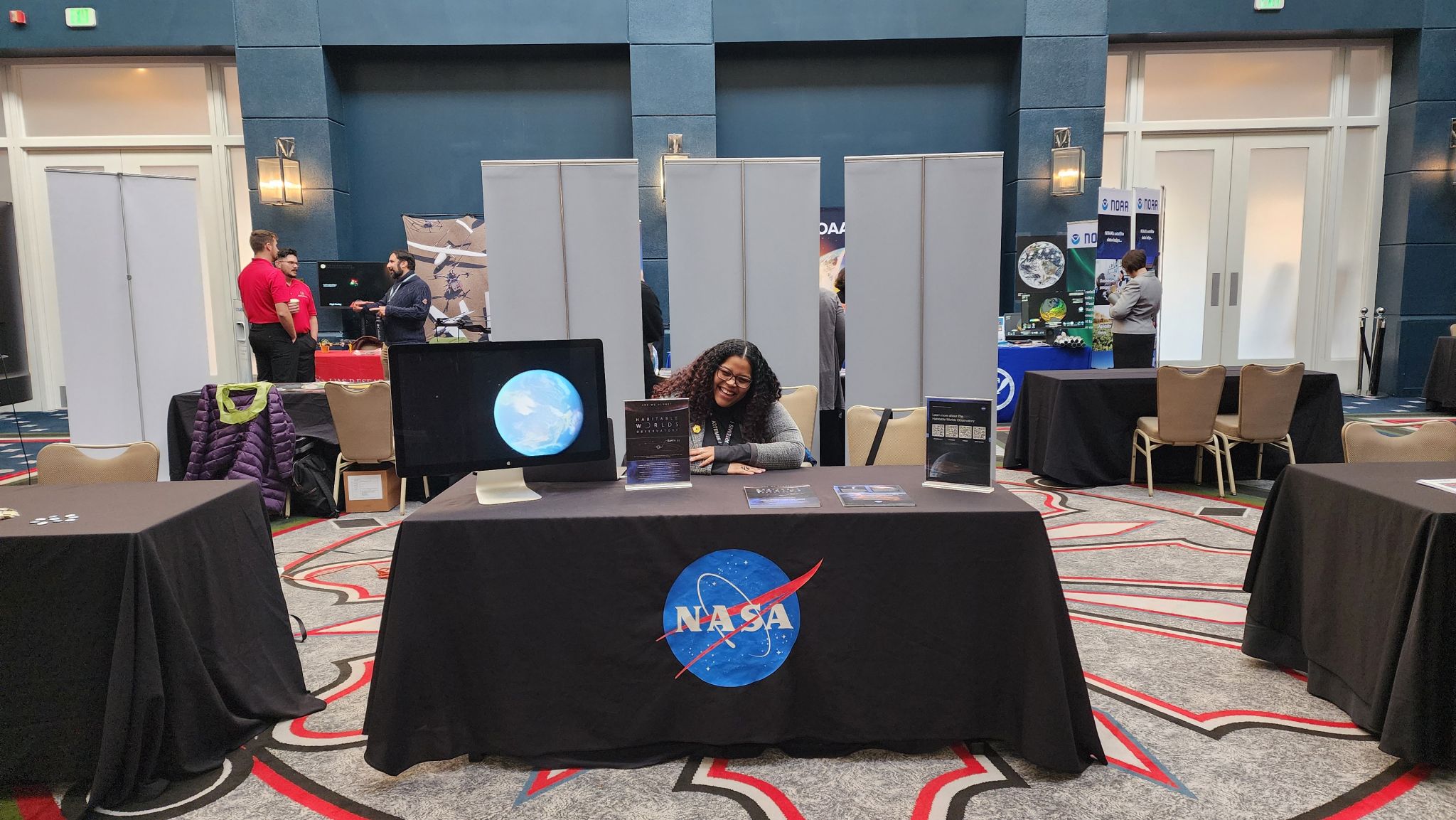
My upcoming mission is so upcoming that it is still in the planning stages! I work on communications for the Habitable Worlds Observatory. What excites me most, other than the fact that it will search for life on other planets, is that we’re doing comms earlier than usual. HWO is still in pre-phase A (an early conceptual stage) while most flagship missions don’t start heavy communications work until much later, around phase C. That means we get to do a lot of strategic thinking about how to frame the mission before it even leaves the concept space.
Most NASA comms focuses on reporting what the mission is. With HWO, we get to explore what the mission can become. That shift is powerful because it invites people to imagine the future with us and contribute their own ideas. I’ve started calling it “the people’s telescope” for that reason.
Another part I love is that we’re showing science as it really happens: iterative, uncertain, and always changing. Normally, the public only sees polished results, but with HWO, we’re inviting them behind the scenes. Even when the telescope design changes in a couple of years, people will have seen the reasoning, the debates, and the process that shaped it. I think that’s just as important as the result: it humanizes science and shows that discovery is rarely a straight line. You can keep up with HWO at nasa.gov/HWO.
What early career advice do you have for those looking to do what you do?
I’ve never accomplished anything in a straight line (are you sensing a theme yet?). I know how tempting it is to want the stability of a perfect plan, but the truth is that staying open and flexible is how you find the opportunities that are right for you.
If you wrestle with anxiety like I do, or even if you don’t, one piece of advice I give myself often is: notice when you’re worrying too much about the future. You can’t control what’s down the road, but you can act in the present.
The same goes for people. Sometimes others will underestimate you or even choose to misunderstand you. Let them. Don’t worry or waste your energy fighting those battles. Find better people that will support and lift you up. Shout out to NASA-PEER and to all my mentors!
And finally: don’t be afraid to ask for what you need, whether that’s funding, an accommodation, or an extension. Ask if you can help with a project, ask for the extra day off, ask someone for tips on how to accomplish something. Be shameless about this. The worst someone can say is no.
What is one space mission that you are particularly excited about, and why?
The Moon and human space exploration are topics close to my heart, so I'm naturally excited about Artemis. I've been fortunate to learn about and work at intriguing lunar analogs like the San Francisco Volcanic Field in Arizona and Mauna Loa in Hawai'i. Standing in those landscapes, it’s easy to imagine yourself on the Moon.
During ground-penetrating radar work in Arizona—one of my first field experiences—I was humbled by the unforgiving terrain. But while doing petrographic analysis on some thin sections from samples we picked up, I discovered a xenocryst (a foreign crystal trapped in magma) with a distinct center and rim, each composed of different minerals. The team presented findings at GSA 2023 and AGU 2023 incorporating this work. We were able to date multiple lava flows in the region, including correctly attributing one flow to a spatter rampart called The Sproul, which dammed the Colorado River. Witnessing this project evolve from site selection to presentation was an invaluable lesson in collaboration, an important part of mission work.
The teamwork that enables humans to do similar work on another planetary surface blows my mind. It’s the kind of thing that makes me stop and appreciate that we are creating real sci-fi movie plots in building 34. I feel really lucky to be able to see that in my lifetime.
What do you like to do in your free time?
My interests are pretty eclectic. Basically, I split my free time between music, making things, and dressing like a Victorian goth tea party guest.
I love music: I listen every day, dance, sing along and DJ with my partner, either at home or the occasional gig. Sorry if you missed the 2024 660 holiday party! You should also hear my Pearl Jam or Alice in Chains karaoke covers. I go to a lot of concerts and house music shows.
I enjoy making things with a camera (living in DC has made me appreciate architecture) or crafting with laser cutters, or anything I have around the house, when I can find the time.
And then there’s Japanese fashion, specifically EGL (Elegant Gothic Lolita). It’s Harajuku-born, rooted in Victorian clothing with gothic and romantic vibes. For me, it’s more than just fashion; it’s about reclaiming ideas of beauty that I didn’t grow up seeing in myself. If you allow me to make one final reach and connect two unlikely things, I think it’s like space exploration. You get to try on new worlds, new perspectives, and find joy in places you didn’t expect.
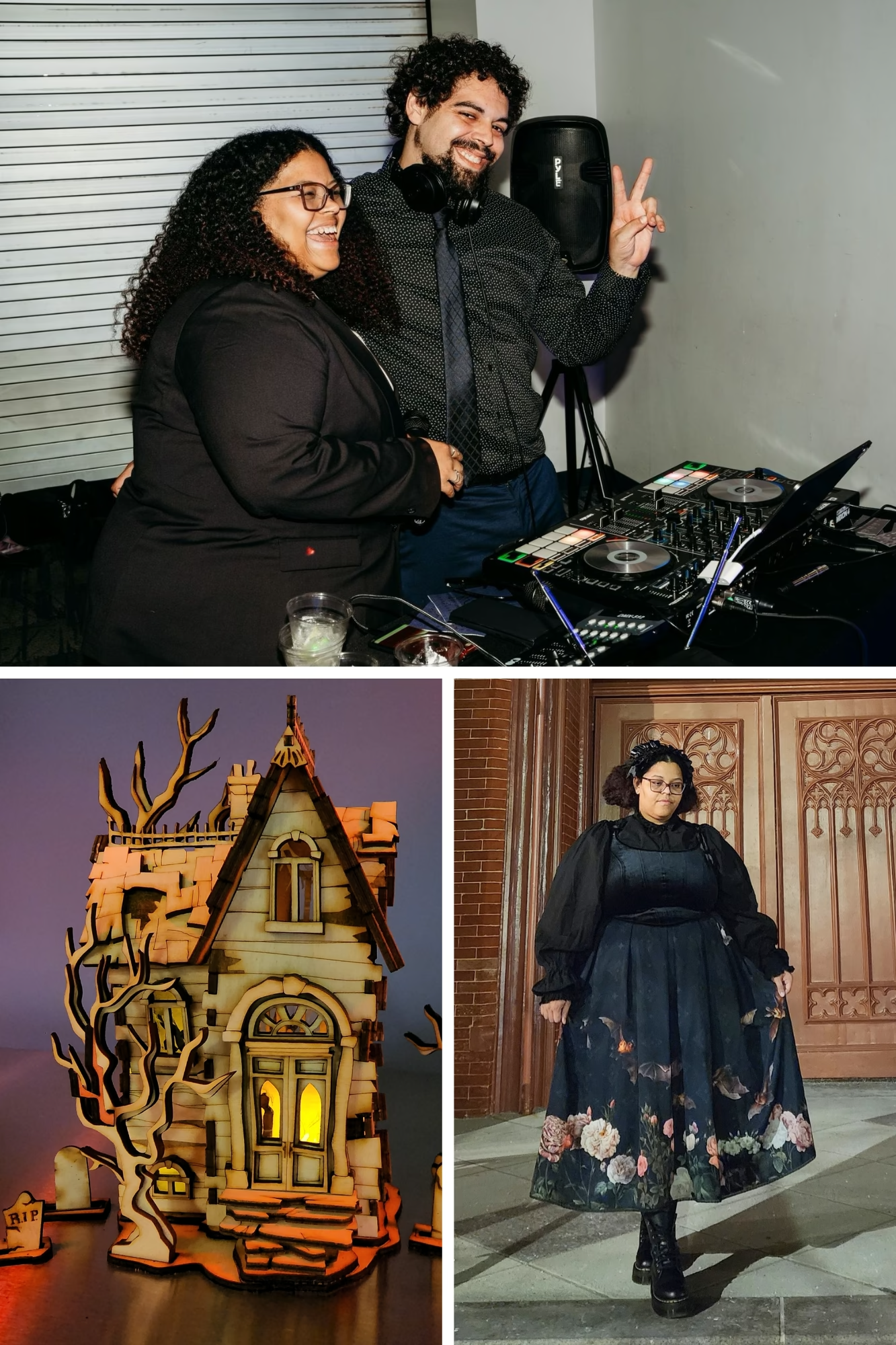
(Bottom left) A laser-cut haunted house.
(Bottom right) A Nosferatu-inspired photoshoot.
Published Date: Jan 30, 2026.
Hometown:
Wynwood, Miami, FL
Undergraduate Degree:
B.A. Geology, University of Florida, Gainesville, FL