

Home
Simplesat is an engineering experiment in the form of a small satellite. It will try to determine whether an inexpensive satellite can be constructed from commercial parts and survive in orbit. It contains a GPS receiver capable of determining the orientation of the satellite. This orientation information will be used to try to control the pointing direction of the small telescope onboard the satellite.
Simplesat was launched on August 10, 2001 on the Orbiter Discovery for mission STS-105. After visiting the Space Station the crew will use a spring ejection system to place Simplesat in its own orbit. The Orbiter will then return to Kennedy Space Center.
Simplesat will orbit the Earth for about 5 months before atmospheric drag will cause it to re-enter. During that time engineers at Goddard Space Flight Center will attempt to communicate with Simplesat using ham radio style equipment.
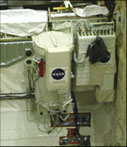
SimpleSat in a HitchHiker Can in the Space Shuttle Payload Bay |
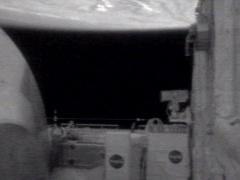
Earth hangs above the Orbiter |
|---|